

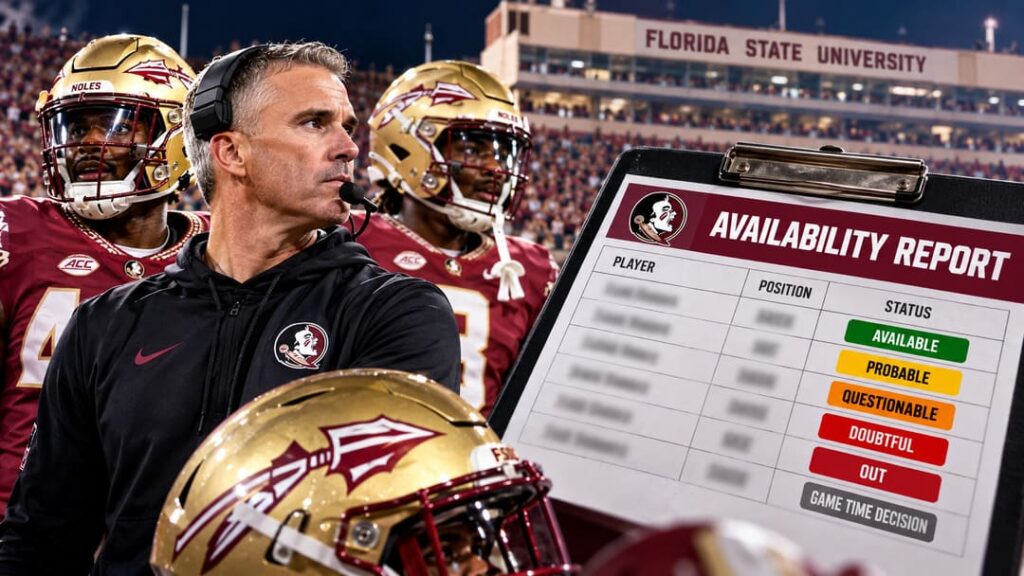
FSU availability reports answer one part of a difficult pregame question: who is expected to play? They do not tell fans how Florida State will divide snaps, replace an absent starter or organize a rotation. With the Seminoles visiting Louisville on Friday, October 9, 2026, at 7 p.m. Eastern, separating participation status from playing time offers a more useful starting point than collecting injury rumors.
For readers who also follow betting markets, the JustBet sportsbook review and rating addresses a separate question: how the operator’s banking, terms and service measure up. That review is not evidence of an athlete’s availability. Keep operator research separate from team news, and do not treat either as a guarantee about a wager.
The practical task is to attach three things to every personnel update: the game it concerns, the report’s timestamp and the player’s role. A familiar name beside a reassuring label is not enough to explain how an entire unit will function.
Read FSU Availability Reports on the Right Clock
The ACC’s availability reporting rules require football updates on each of the three nights before a conference game, followed by a game-day report two hours before kickoff. For FSU–Louisville, that means a Tuesday-through-Thursday sequence and a scheduled 5 p.m. Eastern game-day update on Friday.
That timing explains why an old screenshot can mislead. A Tuesday listing documents Tuesday’s assessment, not Friday’s selection. Before interpreting a name, check that the report concerns the correct opponent and has not been superseded.
It also gives fans a better way to organize their reading. Use the early report to identify unresolved personnel questions. Use subsequent updates to track changes. Then consult the game-day release rather than carrying an earlier assumption into kickoff.
The Labels Change on Game Day
The ACC distinguishes between pregame-week designations and game-day decisions. The following comparison summarizes what each communicates, rather than treating every appearance on a report as an absence.
| Designation | When used | What it communicates |
|---|---|---|
| Available | Before and on game day | Available for participation; no snap total supplied |
| Probable | Before game day | Participation expected; 75% designation |
| Questionable | Before game day | Participation uncertain; 50% designation |
| Doubtful | Before game day | Participation unlikely; 25% designation |
| Out | Before and on game day | Not participating in that contest |
| Game Time Decision | Game day | Decision remains pending nearer kickoff |
The analytical distinction is between appearing and producing. A participation category cannot establish how many carries a running back will receive, how frequently a defender will rotate or which situations a coach will assign to a returning player.
Availability is not a workload forecast. That remains true even when the uncertainty about participation has been resolved.
An Availability Report Is Not a Diagnosis
Availability reporting covers more than injuries. When the ACC introduced the system, it explicitly included illness, eligibility questions and personal or family matters, while keeping the underlying reason out of the public report. A listing therefore does not, by itself, establish that someone is injured.
That boundary matters for accurate Florida State coverage. Do not assign a recovery timetable from a status label, or turn a practice observation into a medical conclusion. A confirmed explanation from the program can add context; a lack of explanation does not justify speculation.
The same discipline applies when someone moves between categories. The defensible statement is that his published status changed. Explaining why it changed requires separate evidence.
For readers, this is not merely cautious wording. It prevents an availability guide from becoming an unofficial diagnosis board and keeps attention on information that can actually be established.
Louisville Week Shows Why the Player’s Role Matters
Florida State’s initial report on Tuesday, October 6, listed defensive lineman Darryll Desir as questionable and linebackers Mikai Gbayor and Karon Maycock as probable. Those were early-week assessments, not confirmed Friday workloads.
Read that grouping as a prompt to examine responsibilities, not simply count names. Desir’s listing raises a defensive-front rotation question. The linebacker listings raise different questions about available combinations and substitution options. Neither counting all three as absent nor assuming their usual involvement would follow from those labels alone.
That is the useful connection to Florida State’s linebacker depth challenges: a report becomes meaningful when the reader identifies which responsibility might need covering.
A hypothetical example makes the distinction clearer. Losing one reserve from a well-stocked position and losing the only experienced alternative behind a starter could produce the same one-name addition to an unavailable list. The roster consequences would be different.
The next question should therefore be specific: who would handle the missing assignment, and what evidence supports confidence in that replacement? Without that second step, an injury count is an incomplete description of a football problem.
Do Not Turn a Status Update Into a Betting Conclusion
New information is not a complete matchup evaluation. Before drawing conclusions from an update, establish what changed, whether it concerns a starting or rotational responsibility, and what remains unknown.
Consider an offensive tackle ruled out in a hypothetical matchup. The important issue is not simply losing one player. It is whether the replacement can handle the same protection duties and whether providing extra help would change the available passing options. Those are football questions that a designation cannot answer.
Apply the same standard to betting commentary. Do not use a changed price to “confirm” an unreported absence. Establish the personnel fact first and leave any explanation of market movement conditional unless it has supporting evidence.
For Seminoles fans, the best use of FSU availability reports is neither ignoring them nor asking them to reveal more than they contain. Read the latest assessment, understand the affected role and keep unresolved questions visible. Once the game begins, watch the actual rotation: that is where participation status becomes observable football usage.