


The Miami Home Advantage is not just crowd noise for Florida State on Saturday, October 17, 2026; it is a stress test of line play, poise, and whether the Seminoles can make the rivalry feel less like a track meet on Miami’s terms. The local angle in Tallahassee is clear: FSU’s best route through Week 7 starts with shrinking Miami’s easy downs and giving its own offense enough balance to stay out of panic mode.
Miami entered this matchup with the clearer statistical profile. The Hurricanes were listed at 49.6 points per game, while Florida State was listed at 31.0. That gap matters because it shapes how both sidelines manage risk. FSU cannot treat every drive like it needs a quick answer, but it also cannot spend the first quarter feeling out a defense that has punished rushing attacks.
Miami Home Advantage And The First Ten Minutes
Road rivalry games often tilt before the stat sheet catches up. A false start, a stuffed run, one missed tackle in space, and the home side begins to play faster. Florida State’s opening priority should be emotional control expressed through football basics: clean substitutions, steady cadence, and early contact at the line of scrimmage.
How Miami Home Advantage Shows Up Early
Miami’s home edge has been backed by results. Research on the matchup credits the Hurricanes with a 12–1 home record in ACC play across the 2024 and 2025 seasons. That does not guarantee anything on October 17, 2026, but it tells FSU what kind of game it is walking into: one where the Hurricanes have been comfortable turning home starts into scoreboard pressure.
That is where Miami Home Advantage becomes a practical football problem. Florida State has to avoid the sequence that burns road teams: first-down loss, obvious passing down, crowd rising, pressure package, rushed throw. A slow start would feed the very setting FSU is trying to quiet.
The First Script Cannot Be Passive
The Seminoles’ opening script should not mean throwing the ball recklessly. It means showing Miami that every part of the field is in play. If Florida State begins with inside runs into a loaded front and waits for the passing game to rescue third-and-long, Miami’s defense gets to dictate the shape of the game.
FSU’s better path is to test edges, mix quarterback movement, and use early throws that are closer to extensions of the run game than low-percentage shots. That approach can buy rhythm for the offensive line and give quarterback Ashton Daniels defined answers before the pass rush can turn the game into a long series of obvious dropbacks.
Where FSU’s Offense Can Push Back
The central matchup is simple to name and hard to solve: Florida State wants to run well enough to keep the entire playbook alive, while Miami has been one of the toughest run defenses in the country by the available research. Miami had allowed just 213 rushing yards through five games, about 42.6 rushing yards per game and roughly 1.84 yards per carry, according to SI’s matchup breakdown.
That same matchup frame also points to why Tallahassee should not dismiss FSU’s offensive path. The Seminoles have been listed at 187 rushing yards per game and close to 4.8 yards per carry. Ousmane Kromah was credited with 565 rushing yards through six games, around 5.65 yards per carry, while Daniels had 323 rushing yards and 10 rushing touchdowns as of October 12, 2026. Those numbers do not erase Miami’s front, but they show Florida State is not entering this game without a ground identity.
Making Miami Home Advantage Less Predictable
For FSU, reducing Miami Home Advantage starts with making Miami defend uncertainty. Daniels’ rushing threat changes the math if Florida State can keep down-and-distance manageable. The key is not simply calling more quarterback runs; it is using his legs to hold backside defenders, slow pursuit, and create room for Kromah to press creases before the front closes.
The danger is negative plays between the tackles. If the Hurricanes create second-and-12 too often, FSU’s passing-game concerns become louder. The research profile points to low passing efficiency markers and a need for explosive passes to discourage Miami from crowding the box. That does not mean chasing deep balls on every possession. It means picking spots where formation, motion, or run action gives a receiver a clean angle rather than asking the offense to win isolated hero plays.
Third Down Is The Real Ranking Metric
Third down gives us one of the clearest measuring sticks for this game. The research lists Florida State at about 43.5% on third-down conversions, while Miami’s defense allows about 34.9%. That gap is not massive, but the context is. On the road, third-and-3 can feel like a play call; third-and-8 can feel like a negotiation with noise, pressure, and the clock.
FSU’s best third-down plan begins on first down. Four yards on first down, even without a highlight, changes the menu. It lets the Seminoles use tempo, motion, and quarterback run possibilities. Zero yards on first down lets Miami compress the field and attack protections. That is why the run game is not just about total yardage. It is about how often Florida State stays out of the exact situations Miami wants.
- Early downs: FSU needs efficient first-down gains that prevent Miami from teeing off in long-yardage looks.
- Explosive throws: The Seminoles need enough vertical or intermediate success to keep safeties honest.
- Ball security: Empty possessions caused by giveaways would amplify the home field and shorten FSU’s margin.
Defensive Answers For Tallahassee Confidence
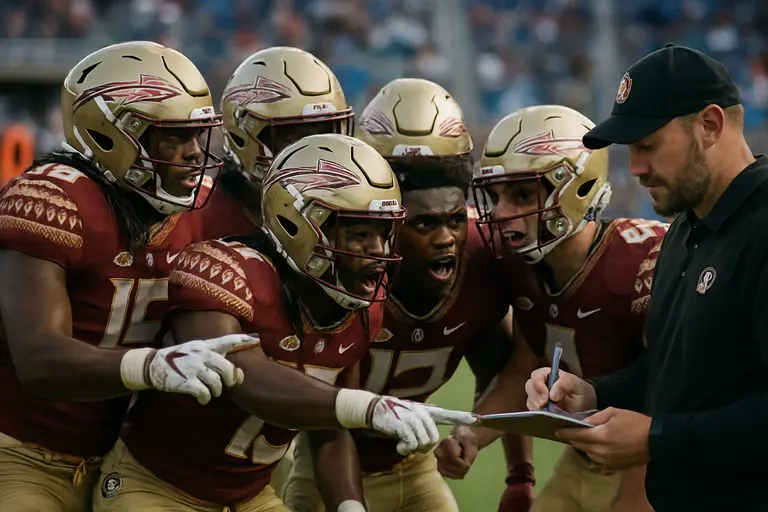
Florida State’s defense enters this matchup with a different kind of burden. Miami’s scoring average puts pressure on every possession, and the Seminoles have been listed at 25.3 points allowed per game. That combination can tempt a defense into chasing big stops instead of building steady ones. Against Miami, the better target is forcing the Hurricanes to stack long drives without free field position.
Field Position Must Become A Team Stat
Field position will not belong only to the punter or return group. It will be shaped by offensive risk, third-down defense, tackling after catches, and penalties. If Florida State gives Miami short fields, the Hurricanes’ scoring profile becomes even more difficult to manage. If FSU can make Miami start deeper and snap the ball more often, the road environment starts to lose some of its edge.
Jimbo Fisher’s public analysis of the matchup pointed to turnovers and early big plays as ways Florida State could alter momentum, as covered in On3’s Fisher breakdown. That fits the broader film-room logic. Road underdogs do not need chaos on every snap, but they often need one or two game-state changes that make the favorite uncomfortable.
Depth And Local Rivalry Pressure
Rivalry games also test roster depth because emotion can hide fatigue for only so long. Florida State needs rotation discipline on defense, especially if Miami plays fast after explosive gains. Tallahassee discussion has already centered on availability and matchup stress; for a related angle, our recent look at FSU Miami absences tracks why depth keeps showing up in rivalry talk.
The Seminoles do not need to win every category to stay in the game. They need to win enough of the hidden ones: missed tackles avoided, penalties reduced, sudden-change snaps handled, and red-zone possessions forced into tighter windows. Those are not flashy metrics, but they are often where road teams keep the fourth quarter meaningful.
What Florida State Must Prove At Miami
The Seminoles’ clearest assignment is to make this game feel slower than Miami wants. That starts with the offense proving it can run into a defensive strength without becoming stubborn. Kromah’s production and Daniels’ rushing value give Florida State a real foundation, but the blocking angles, play sequencing, and passing counters must be sharp enough to stop Miami from squeezing the field.
The Path Is Narrow, Not Invisible
The research outlook gives Miami the stronger profile, and the home setting adds to that advantage. Still, FSU’s path is not imaginary. It runs through early-down efficiency, controlled quarterback movement, selective explosive passes, and a defense that refuses to hand Miami short fields. The Seminoles also need the kind of turnover or early momentum swing Fisher described, not as a wish, but as a practical way to change how the Hurricanes call the game.
If Miami Home Advantage becomes the story for four quarters, Florida State will likely spend too much of Saturday reacting. If FSU can turn the first quarter into a possession-by-possession fight, Tallahassee gets a more useful read on this team’s growth: not whether the Seminoles can silence a road stadium completely, but whether they can make Miami earn every bit of comfort on October 17, 2026.