

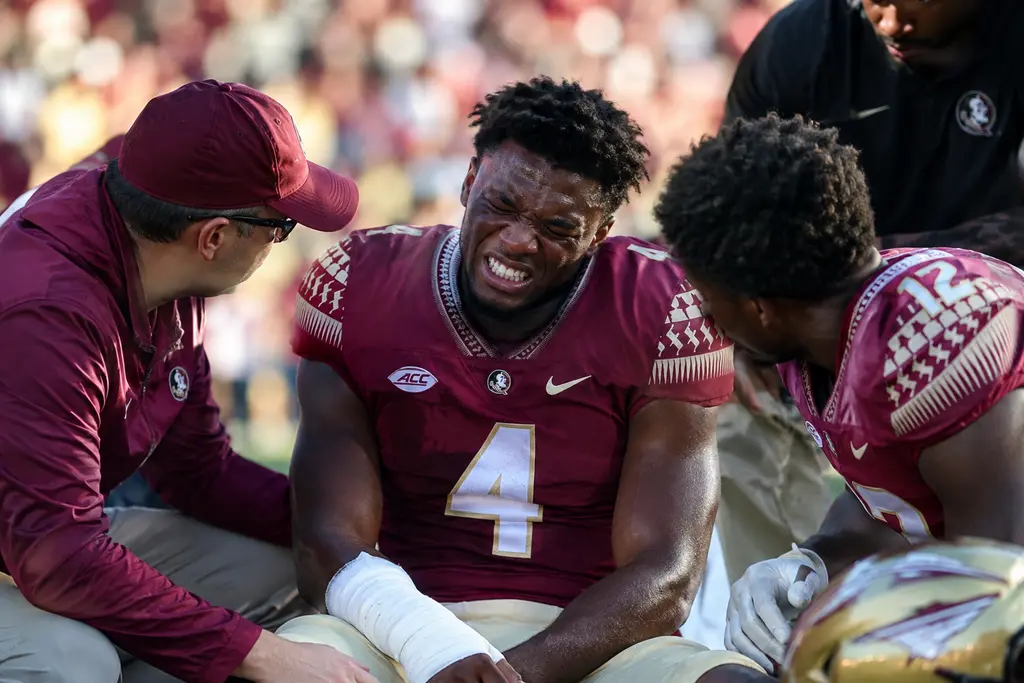
The story around FSU running backs shifted fast before Florida State’s scheduled game against Clemson on Saturday, October 31, 2026, in Tallahassee, where the injury report included multiple Seminoles starters ahead of the ACC matchup, according to AOL’s Clemson-FSU injury report. For a program that has leaned on physical balance as part of its identity under Mike Norvell, this is not just a depth chart problem. It is a test of trust, rhythm and how much the offense can ask of players whose roles changed in midseason.
Ousmane Kromah’s left ankle injury against Miami on October 17, 2026, took away the top rushing presence in the room. Samuel Singleton Jr. has remained unavailable with a lower-body injury suffered earlier in the season against Alabama. That leaves Florida State with a smaller group, a different snap distribution and a Clemson game that will say plenty about how quickly the staff can reshape the run game without turning the offense into something it is not.
Why FSU running backs Took The Hardest Hit
The Loss Of Kromah Changed The Baseline
Kromah’s absence matters because his role was not decorative. The research notes describe him as the steady workhorse of the backfield, a player whose week-to-week rushing production gave Florida State a reliable starting point. When a back like that exits the plan, the first issue is obvious: carries have to go somewhere else. The second issue is harder to solve: the offense loses the familiar down-to-down feel that comes from a runner who has already proven he can carry volume.
That matters in Tallahassee because the running back position has long been tied to the way fans understand Florida State toughness. The names change, the offensive systems change, but the expectation remains. A back who can keep the offense on schedule is not only a stat line; he is part of how the crowd feels a game settling in. Without Kromah, every second-and-5 and third-and-2 takes on a slightly different weight.
Singleton’s Absence Narrows The Options
Singleton’s continued absence compounds the problem. Norvell used the bye week before Clemson to evaluate personnel packages and possible adjustments, with running back depth among the main pressure points, as reported by Yahoo Sports on FSU’s bye-week priorities. The important part is not simply that another back is unavailable. It is that Florida State lost two players the staff viewed as high-end options, forcing the remaining group to answer questions that were not supposed to arrive all at once.
That is where the human side of roster building comes in. Injuries do not wait for ideal timing. A freshman may be asked to play beyond his prior workload. A special teams contributor may suddenly need to handle offensive detail. A reserve may be one snap away from a meaningful series. For FSU running backs, the Clemson week became less about waiting for perfect readiness and more about preparing available players to function with confidence.
Wisner’s Lead-Back Audition
Why Tre Wisner Fits The First Answer
Tre Wisner is the logical first answer because he has already shown he can contribute in more than one phase. Through seven games, the research notes credit him with 38 carries for 204 yards, close to 5.4 yards per carry, plus 12 catches for 151 yards and one touchdown. Against Miami on October 17, 2026, he stepped forward after Kromah’s injury with 63 rushing yards on nine carries and 56 receiving yards with a touchdown, though the fumble in that game remains part of the evaluation.
That profile is valuable because Florida State may not need Wisner to copy Kromah’s exact role. It may need him to become the connector: a back who can run enough to keep Clemson honest, catch enough to punish pressure and stay solid enough in protection to keep the full call sheet open. That is a different kind of lead-back responsibility than simply taking 20 handoffs.
Ball Security And Workload Will Shape Trust
The fumble against Miami cannot be ignored, but it also should not define the entire discussion. Coaches grade far more than the public box score, and a back’s response after a mistake often carries weight inside a program. Still, Clemson is not the kind of opponent that allows loose possessions to fade into the background. If Wisner is the lead back, ball security becomes part of the strategy, not a side note.
His receiving value also gives the staff a way to protect a thinner room. Short throws can work almost like extended handoffs. Screens, flares and option routes can get the ball to a back without asking the offensive line to win every interior gap. That does not replace a running game, but it can reduce repeated collisions while giving Wisner touches in space.
How The Clemson Plan Changes In Tallahassee

Thomas, Parks And Markey Face Different Jobs
Amari Thomas and Zay Parks are the names most likely to feel the change behind Wisner. Thomas has had minimal usage in the research notes, which makes his role a development test as much as a game plan decision. Parks has been involved on special teams and is being asked to help at running back, which means his value may come from reliability, assignments and ball security as much as yardage.
Gavin Markey has been described as a reserve and special teams contributor. That does not mean his role is minor inside the building. Thin position rooms turn practice habits into game-day insurance. One missed block, one special teams snap, one short-yardage rep can matter. For FSU running backs, Clemson week is a reminder that depth is not an abstract roster word. It is a lived reality for players who may spend most of September waiting and then find themselves central by late October.
The Passing Game Becomes A Partner, Not An Escape
The natural reaction to running back injuries is to assume Florida State will throw more. That may be true in moments, but the better question is how the pass game supports the run game rather than replaces it. If the staff can use quick throws, motion and formation variety to keep Clemson from crowding the line, Wisner and the younger backs may find cleaner looks.
This is also where Norvell’s offensive identity matters. The Seminoles do not have to abandon balance to protect a thinned position group. They can change the way balance is created. A first-down pass to a back, a perimeter throw that widens linebackers, or a formation that forces Clemson to declare coverage can all help the backs before the snap.
For readers tracking the same staff decisions from the bye week, our related breakdown of Norvell’s Clemson reset connects the running back questions to the wider roster choices Florida State faced in late October.
- Wisner’s touches: The staff has to balance lead-back volume with the need to keep him fresh for late possessions.
- Thomas’ early snaps: A few clean first-half reps could help settle a freshman before higher-pressure downs arrive.
- Parks’ assignment value: His special teams background may matter if the staff trusts his detail and toughness.
- Pass-game support: Throws to backs and quick perimeter concepts can help reduce strain on the room.
What Clemson Means For FSU running backs
The Clemson game on October 31, 2026, became a measuring stick for the position room sooner than Florida State wanted. That does not make it a lost cause. It makes it a revealing one. The coaching staff has had the bye week to sort roles, and the remaining backs have had time to hear a clear message: expectations do not drop simply because the room is shorthanded.
For the Tallahassee community, this is the kind of week that often reshapes how fans talk about a player. Wisner has a chance to move from useful contributor to central figure. Thomas can start building a game-day identity. Parks can prove that special teams toughness can translate into offensive trust. Markey can stay ready for the kind of moment that rarely sends advance notice.
That is the real impact of the injuries. They changed more than the carry count. They changed the emotional center of the offense, placing attention on preparation, patience and adaptability. If FSU running backs hold up against Clemson, it will not erase the loss of Kromah or Singleton. It will show that the room still has enough structure, coaching and player buy-in to keep Florida State’s offense from becoming one-dimensional at a critical point in the schedule.