

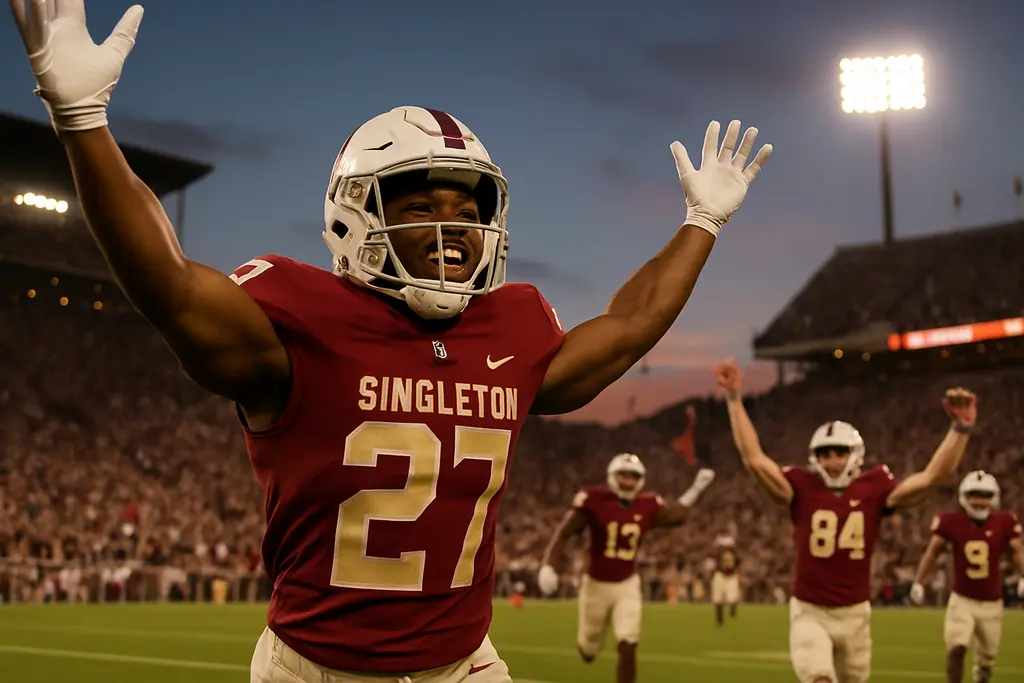
The Samuel Singleton impact on Florida State’s offense became clearer after his lower-body injury at Alabama on September 19, 2026, not because one player defines a full season, but because Singleton had already touched nearly every phase of the Seminoles’ attack. Through the first three games of the 2026 season, he had 20 carries for 76 rushing yards and one rushing touchdown, plus eight catches for 162 receiving yards and two receiving touchdowns, according to On3’s FSU report. For an offense trying to build rhythm in Tallahassee, that kind of run-pass value is not a footnote. It shapes play-calling, defensive attention, field position, and the emotional pulse of a sideline.
How Samuel Singleton Impact Showed Up Early
Florida State did not need a month of games to see Singleton’s value. His early 2026 work showed a player who could live between labels. Running back? Yes. Slot-adjacent receiving threat? At times, yes. Kick return option? Also yes. That blend matters because college defenses often look for tells: personnel, alignment, down-and-distance habits, and who stays on the field when the offense shifts tempo. Singleton made those reads less tidy.
Samuel Singleton Impact Before The Injury
The early production was not empty yardage. Singleton’s receiving totals through three games were especially meaningful because they came from a player listed in the backfield. When a back catches eight passes for 162 yards and two scores across three games, linebackers have to widen, safeties have to communicate faster, and defensive coordinators have to decide whether they trust base personnel in space.
That is where the Samuel Singleton impact had its clearest football value. He was not just another carry-share piece. He gave Florida State a way to test leverage without always needing a traditional wide receiver screen or a deep shot. For a quarterback, a back who can turn a short throw into a chunk play is a pressure release. For an offensive line, it can slow down aggressive fronts. For the crowd at Doak Campbell Stadium, it adds the kind of sudden movement that changes the mood of a drive.
The Opening-Game Snapshot
His season opener against New Mexico State on August 29, 2026, framed the point. The research notes credit him with 164 all-purpose yards in that game: 42 rushing yards and a touchdown, 54 receiving yards and a touchdown, and 68 yards on two kickoff returns. He also led Florida State in receptions and receiving yards in that matchup. One game never tells a full season story, but it can reveal how a staff wants to use a player. In Singleton’s case, FSU seemed comfortable letting him affect the game from multiple launch points.
That matters locally because Tallahassee has always understood the difference between a productive player and a player who changes how a Saturday feels. Singleton’s touches were not just numbers on a stat sheet. They were chances for the offense to find tempo, for the special teams unit to steal field position, and for fans to see a young playmaker grow into a larger role.
Why The Alabama Injury Changed The Offense
The injury at Alabama interrupted more than a hot start. It forced Florida State to account for lost versatility. Coach Mike Norvell later said Singleton would be out for an “extended period of time,” while also indicating hope that he could return during the season, per Norvell’s update. That phrasing left room for optimism, but it also confirmed that the Seminoles had to adjust without treating the absence as a one-drive problem.
The 65-Yard Play And The Sudden Shift
The most painful part of the Alabama sequence was the timing. Singleton produced a 65-yard catch-and-run on third down in the second half, a play that helped set up one of Florida State’s touchdowns, before later being ruled out, as reported by Yahoo Sports. That single play captured his usefulness: third down, space, acceleration, and a drive-altering result.
Afterward, the visible signs of the injury added concern. The Yahoo report noted that he was shown with a brace on his right knee and using crutches as he left the field and locker room area. The specifics of recovery belong to the program and medical staff, but from a football standpoint, the effect was plain. Florida State lost a player who had already become a bridge between the run game, passing game, and return game.
What An Extended Absence Removes
A versatile back changes offensive math. Without Singleton, FSU had to find answers in several areas at once:
- Receiving stress: His eight catches for 162 yards in three games gave defenses a backfield target they could not ignore.
- Rushing balance: His 20 carries offered a change of pace and kept the backfield rotation from leaning too heavily on one profile.
- Return-game value: His opening-game kickoff return work showed he could help the offense before the first snap of a drive.
- Defensive hesitation: His presence made it harder for opponents to treat FSU’s personnel groupings as predictable.
That kind of absence does not always show up in one box score. It shows up in fewer easy completions, fewer mismatches against linebackers, and more pressure on other backs to provide not only yards, but also formational flexibility.
The Depth Question For Tallahassee

Every injury creates a football problem, but in Tallahassee it also starts a community conversation. Fans at work, on campus, at youth practices, and around pregame tables tend to ask the same question in different ways: who absorbs the missing touches, and does the offense still feel like itself?
Sharing The Work Without Rewriting The Identity
Florida State’s answer could not be as simple as handing every Singleton touch to one player. His role was too spread out. Replacing a carry is one thing. Replacing a back who can catch, return, and threaten space is something else. The staff had to weigh whether to keep the same concepts with different personnel or reshape certain calls around the available backs and receivers.
That is why the injury had a wider effect than the running back room alone. If a receiver has to take more perimeter touches, the route tree changes. If another back becomes the checkdown answer, protection rules and timing matter. If the return game changes, drive starts can shift. For readers tracking the rushing side specifically, our related analysis on FSU’s run-game depth fits into the same discussion.
Why Fans Felt The Absence
The Samuel Singleton impact was easy to feel because he offered the kind of play style that makes a fan base lean forward. Not every touch was explosive, but each carried the possibility of forcing a missed angle. That has value in a stadium and value inside a huddle. Teammates know when a player can turn a modest call into a first down. Coaches know when a player can make a third-and-medium call less stressful.
In a college town, those details spill beyond the facility. A player’s rise becomes part of the weekly rhythm. Families discuss it after games. Former high school coaches use it as a teaching point. Younger athletes see a path from role player to trusted offensive piece. Singleton’s injury pause did not erase that growth. It made it more visible because the offense had to account for what was missing.
What Samuel Singleton Impact Means For FSU
The Samuel Singleton impact should be judged through more than one lens. Statistically, his first three games gave Florida State rushing production, receiving production, and special teams value. Tactically, he gave the offense a flexible piece who could stress defensive spacing. Culturally, he represented the kind of player development story that resonates in Tallahassee: speed, role growth, and a chance to become more than a situational contributor.
A Player Whose Value Crossed Roles
Singleton’s early 2026 profile was not built on volume alone. Twenty carries through three games did not make him a workhorse. Eight catches did not make him a full-time receiver. Two kickoff returns in the opener did not make him only a return specialist. His value came from the combination. Florida State could use him as connective tissue between phases, and that is often where good offenses find their extra yards.
His 65-yard catch-and-run at Alabama will stand as the sharpest example from the pre-injury stretch. It came on third down, created a scoring opportunity, and showed why defensive patience can break when a back has open grass. The play also made the later injury feel even more abrupt. One moment, Singleton was helping tilt a drive. Soon after, Florida State was adjusting to life without him for an extended period.
The Community Lens On A Football Setback
For FSU supporters, the story is not only about scheme. It is about watching a player earn more trust, then seeing that momentum interrupted. The fair reading, as of October 17, 2026, is measured: Singleton had been one of Florida State’s most versatile offensive pieces before the injury, the staff publicly left hope for a return during the season, and the offense had to redistribute responsibilities in the meantime.
That makes his early-season work worth remembering even during the absence. Injuries can shrink a player’s weekly visibility, but they do not shrink the evidence already on tape. Singleton showed burst, receiving skill, return value, and enough backfield production to matter. For Florida State, the challenge was not proving he mattered. The challenge was finding enough answers until his status changed.