

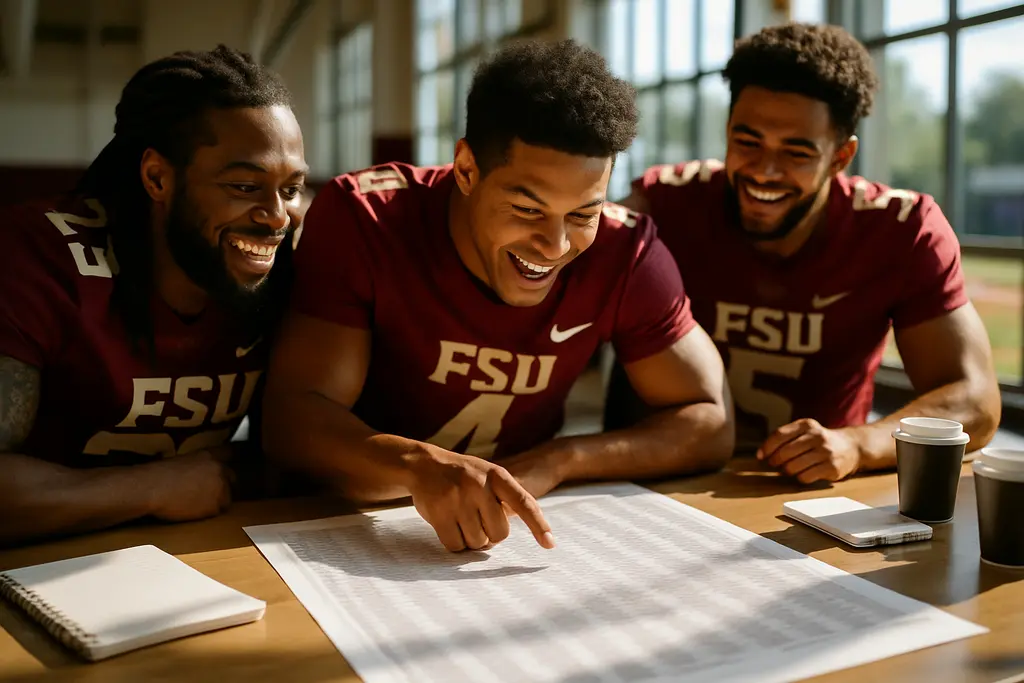
FSU Watch Lists became a useful snapshot of player development across Florida State athletics through 2025 and 2026. The names stretched from a football receiver and defensive lineman to a sprint star, relief arms, draft picks, and incoming baseball recruits. That mix matters in Tallahassee because it says something bigger than award chatter. It shows where the program has produced, where coaches have identified traits, and where national evaluators have started paying closer attention.
I read these lists less like trophies and more like scouting breadcrumbs. A watch list does not guarantee a season, a draft slot, or a record. It does tell us which athletes have earned national awareness before the next set of results gets written. For Florida State, that awareness has touched multiple sports, which gives the local fan base a wider view of how development is being judged outside campus.
The strongest part of this story is the range. Football brought name recognition at premium positions. Track gave Florida State a sprinter who reached rare program territory. Baseball connected preseason respect, draft outcomes, and a 2026 recruiting class that added high-end arms. None of that should be treated as a finished product, but it does create a clear development marker.
Why FSU Watch Lists Matter In Tallahassee
FSU Watch Lists And The Tallahassee Standard
In a local market like Tallahassee, national honors carry a different weight. They feed recruiting conversations, strengthen position-room credibility, and give families a clearer picture of how athletes can be developed at Florida State. The community sees the names on award lists, but coaches see something more practical: proof points for strength training, role growth, technical improvement, and position coaching.
That is especially valuable across sports. A defensive lineman making a national defensive watch list is one kind of signal. A sprinter becoming a Bowerman semifinalist is another. A pitcher landing on a preseason list before being selected in the MLB Draft is yet another. Together, they form a multi-sport argument that Florida State athletes are being measured against national peers, not just conference opponents.
There is also a recruiting effect. Prospects do not choose schools only because of banners or facilities. They study who improved, who got evaluated, and who became more visible after arriving. That is why recognition across several sports can help reinforce the same message: development in Tallahassee is not limited to one position group or one roster.
Football Honors And Receiver Development
Robinson’s Wide Receiver Profile
Duce Robinson gave Florida State one of its most visible 2026 football markers. On August 19, 2026, he was added to the preseason Biletnikoff Award Watch List, and that recognition sat alongside other preseason honors tied to the Maxwell Award, the Wuerffel Trophy, preseason All-ACC recognition, and All-American teams Yahoo Sports reported. For a receiver room, that type of profile matters because it changes how opponents prepare and how young wideouts view the standard in practice.
The football piece of FSU Watch Lists was not only about Robinson. Darrell Jackson Jr., a redshirt senior defensive lineman, was named to the Bednarik Award Watch List on August 11, 2025. His 2024 production included 12 games, 32 tackles, 4.0 tackles for loss, 3.5 sacks, one forced fumble, and one pass breakup. He had also received All-ACC honorable mention earlier. Those numbers were not empty bulk; they reflected a front-line defender who had already put down a statistical base before national preseason recognition arrived.
Jackson’s Defensive Line Baseline
Jackson’s case is the kind coaches often use inside a building. The jump from a productive defensive season to a national defensive watch list gives younger linemen a model. It shows the value of available snaps, disruption stats, and consistency across a full schedule. In recruiting terms, that kind of example helps when Florida State talks to defensive linemen who want evidence that the program can help turn size and traits into national notice.
Robinson and Jackson also represent two very different development paths. One is tied to perimeter skill and offensive volume. The other is tied to trench play, leverage, and week-to-week physical strain. Florida State having both attached to national award conversations gave the football staff two separate examples for two separate recruiting audiences.
Track Speed Became A Program Signal
Walker’s Sprint Season Resonated
Shenese Walker’s 2026 track season stood out as one of the strongest development stories in the group. On June 24, 2026, she became the first female Seminole ever named a Bowerman semifinalist. The Bowerman is awarded annually to the top male and female athletes in Division I track and field, and Walker was listed among the women’s semifinalists on the 2026 Bowerman Watch List NCAA.com confirmed.
Her case had performance substance behind it. During that season, Walker won national titles in the indoor 60 meters and outdoor 100 meters. She also beat world leader Adaejah Hodge in the ACC Outdoor final with a time of 10.88 seconds. For Florida State, that combination of national wins, ACC speed, and Bowerman recognition pushed the track program into a stronger national conversation.
For FSU Watch Lists, Walker’s breakthrough may have been the clearest example of elite performance creating program identity. Speed has always been part of Florida recruiting language, especially across football and track. Walker gave the Seminoles a recent, high-end sprint reference point. That can carry weight with young athletes across Florida who want to see how fast athletes are trained, timed, and tested once they reach campus.
Baseball Recognition And Recruiting Feedback
Pitching Recognition Met Draft Proof
Florida State baseball added the deepest cluster of names. On February 12, 2026, pitcher Max Kuhle was named to the NCBWA Stopper of the Year Preseason Watch List, a list built around top relief pitchers nationally. In the same February 12 release, Trey Beard and Myles Bailey were selected to several preseason All-America teams. Beard was listed as a first-team All-American by Perfect Game, while Bailey earned recognition from Perfect Game, NCBWA, D1Baseball, and Baseball America. Beard also appeared on the Golden Spikes Award Preseason Watch List, and freshman outfielder John Stuetzer appeared on Baseball America’s Freshman of the Year Watch List.
Then the season’s recognition tied into professional evaluation. On March 11, 2026, junior left-handed pitcher Wes Mendes was named to the National Pitcher of the Year Watch List by the College Baseball Foundation. On July 13, 2026, the 2026 MLB Draft concluded with seven Florida State players selected, including Mendes, Bailey, and Beard. Since several of those players had already been tied to preseason or national attention, the draft results gave the recognition a stronger developmental finish.
Recruiting Class Kept The Arm Pipeline Moving
The recruiting side added another layer on July 27, 2026, when Baseball America published its final Class of 2026 recruiting rankings and placed Florida State at No. 19 nationally. The class included two four-star right-handed pitchers: Donovan Thiery and Brayden Harris. Thiery was credited with a fastball up to 98 mph. Harris brought a mid-90s fastball, a sharp breaking ball, and a track record of missing bats.
That is where the watch-list story connects to roster planning. If pitchers are earning preseason attention, then getting drafted, and the next recruiting class includes power arms, the staff has a cleaner story to tell. Development is not just about who leaves for pro baseball. It is about whether the program keeps replacing traits with traits. For readers tracking local roster buildout, our related look at FSU local recruits fits that same idea of turning evaluation into a deeper player pipeline.
What FSU Watch Lists Say About Development
The Shared Thread Across Sports
The shared thread is simple: national recognition followed athletes who had either already produced or carried traits that evaluators respected. Robinson brought a high-profile receiver profile. Jackson had a measurable defensive season behind him. Walker paired championship sprinting with Bowerman-level standing. Baseball spread recognition across relievers, starters, power bats, freshmen, draft picks, and incoming arms.
That is the cleanest read on FSU Watch Lists for Florida State fans. They are not predictions to be treated as guarantees. They are signs that athletes in Tallahassee are entering national evaluation windows across several sports. For recruiting, that matters because prospects and families notice where names surface. For coaches, it helps reinforce development plans. For the community, it gives a fuller picture of Florida State athletics beyond any single Saturday in Doak Campbell Stadium.
The next step is always performance, not publicity. Still, these honors showed that Florida State had multiple athletes and recruits with national visibility by September 3, 2026. In a college town that measures growth closely, that kind of cross-sport recognition is worth tracking with a clear eye.