

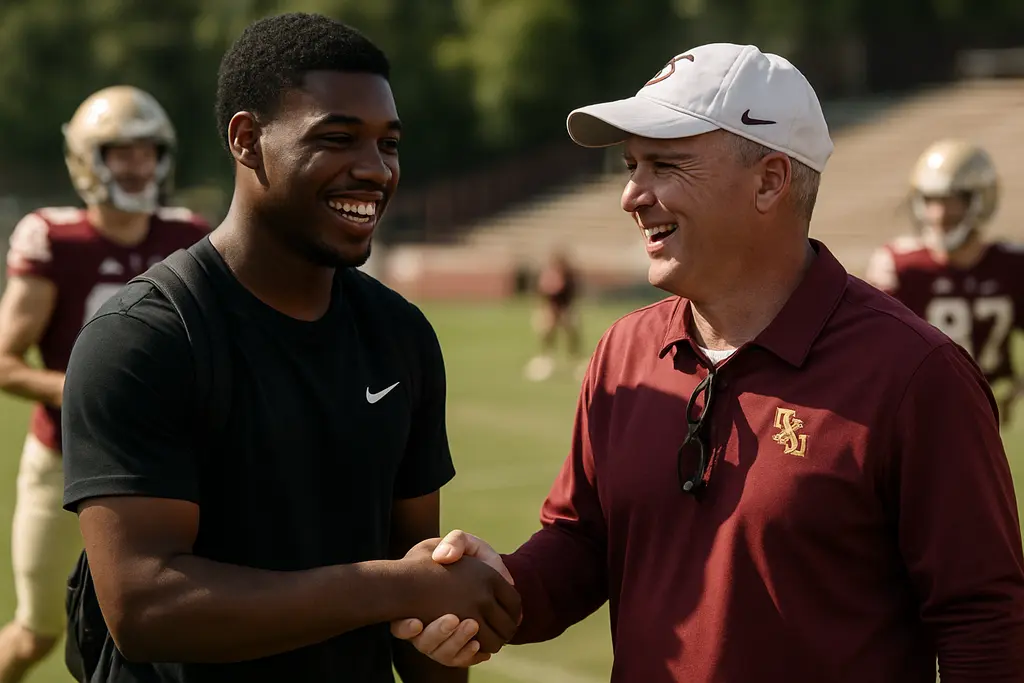
The Derrell Hines Visit scheduled for November 21, 2026, is more than a calendar item for Florida State recruiting. It gives the Seminoles a live, in-stadium opportunity with a Tampa wide receiver who has already been on campus twice in 2026 and is now set to see FSU play in person for the first time.
Hines is a four-star wide receiver in the 2028 class from Carrollwood Day in Tampa, listed at 6-foot-1 and 170 pounds by On3’s 2028 visit tracker. AOL’s recruiting report lists him as No. 96 overall, No. 15 among wide receivers, and No. 13 in Florida in the 247Sports composite rankings, while also reporting that his FSU game-day visit is set for the NC State matchup on November 21, 2026 AOL’s Hines visit report.
For Florida State, that combination matters. Hines is local enough for repeated contact, high-profile enough to draw attention from major programs, and early enough in the 2028 cycle that each campus impression can help shape his read on a staff, a fan base, and a future role.
Why The Derrell Hines Visit Matters To FSU
Derrell Hines Visit And The In-State Receiver Board
The Derrell Hines Visit fits a familiar Florida State priority: keep elite Florida talent engaged before out-of-state powers turn a recruitment into a national tug-of-war. Tampa has long been part of the state’s high-level football pipeline, and Carrollwood Day puts Hines in a region FSU cannot treat as secondary. If a prospect can make multiple trips to Tallahassee without the strain of a cross-country itinerary, the program has more chances to build comfort with the player and his family.
That is why his previous stops matter. AOL reported that Hines visited Florida State in April 2026 for spring practice and again in May 2026 for a camp. Those visits likely offered different evaluation windows. A spring practice trip can show how a position group is coached, how meetings translate to the field, and how a staff interacts when the cameras are not focused on game day. A camp setting can give a prospect a chance to work around coaches and get a better sense of teaching style.
The November 21 trip adds a third layer: the stadium. A game-day visit lets Hines see how Tallahassee feels when the band, student section, alumni, families, and recruits all converge around one football Saturday. The opponent, NC State, also gives the visit an ACC context. For a receiver, the football questions are easy to understand: pace, spacing, route usage, quarterback development, and whether the offense creates chances for wideouts to win outside or after the catch. The bigger question is whether FSU can connect those football details with a local, family-centered pitch.
Why November 21 Carries A Different Feel
A late-November visit can be revealing because the season has already shown what a team is. Early-season visits can lean on optimism and new depth charts. By November 21, 2026, recruits can judge habits: how players respond to a long schedule, how the staff handles substitutions, and whether the energy inside Doak Campbell Stadium still feels strong deep into the fall.
For Hines, this will be his first time seeing FSU play in person, according to AOL. That gives the Seminoles a clear moment to pair the relationship work from April and May with a full game-day presentation. The staff does not need to oversell the basics. It needs to show where a 2028 receiver from Tampa could fit if his development keeps trending upward.
There is also a local identity piece. Florida State’s best recruiting weekends often feel different when in-state prospects can picture their families making the drive, their high school coaches staying connected, and their communities following the move without needing a flight plan. That does not guarantee any decision, but it gives FSU a practical edge it should not waste.
How Game-Day Visits Shape A Recruitment
The Details Recruits Notice
Game-day visits are not just about a seat, a credential, and a few photos. Recruits notice who greets them, how organized the day feels, whether their families are comfortable, and whether current players seem connected to the staff. A top prospect can also compare how different programs treat him in similar settings. Hines has other game-day visits scheduled, including FSU at Miami in Coral Gables on October 17, 2026, along with trips tied to Florida, Texas, Nebraska, Alabama, and Syracuse, per AOL’s reporting.
That schedule turns the Derrell Hines Visit into part of a broader comparison, not a standalone sales pitch. FSU will not be judged only against a brochure version of itself. It will be judged against the feel of rival venues, staff communication elsewhere, and the level of receiver-specific attention he gets from each program. The Seminoles have to make the football fit clear without making the visit feel scripted.
- Family comfort: Travel, access, and staff attention can matter as much as a depth-chart conversation.
- Position fit: A receiver wants to see route structure, targets, spacing, and quarterback rhythm.
- Campus familiarity: Multiple visits help a recruit test whether the first impression holds up.
- Local connection: Tampa-to-Tallahassee ties can help FSU keep the recruitment personal.
For readers tracking this recruitment closely, our earlier look at FSU’s in-stadium recruiting pitch framed why the NC State weekend gives the Seminoles a useful setting. The next step is whether that setting can deepen a recruitment that already includes multiple FSU contacts in 2026.
The Miami Date Adds Context
The October 17, 2026, FSU at Miami trip deserves attention because it gives Hines a chance to see Florida State in a road rivalry environment before he visits Tallahassee for NC State. That order matters. He can watch how the Seminoles travel, how the staff carries itself away from home, and how FSU’s sideline responds inside a rivalry setting in Coral Gables.
Then, about five weeks later, FSU gets the chance to host him. That sequence can help the Seminoles build a two-part argument: the program’s identity travels, and the home environment adds something more. If Hines leaves the Miami game with a stronger sense of Florida State’s sideline and then sees the campus version on November 21, the staff has a more complete story to tell.
What FSU Must Show A 2028 Wide Receiver
Development Has To Be Visible
For a 2028 receiver, the pitch cannot be built only around early attention. Hines has time. He can watch offensive trends, staff stability, player development, and recruiting class structure before narrowing his options. Florida State’s task is to show that its receiver room is a place where teaching is clear, competition is healthy, and young players can see a path without being promised anything unrealistic.
The Derrell Hines Visit should give him a live view of how receivers are used in the offense. Does FSU create separation through formation and motion? Are outside receivers asked to win one-on-one? Does the staff rotate players in a way that shows trust in depth? Those answers will matter more than a generic message about early playing time.
There is also a body-type discussion. At 6-foot-1 and 170 pounds, Hines has the frame of a young receiver still growing into his college projection. Programs will evaluate how he runs, how he catches in traffic, and how much strength he can add without losing movement skills. The visit itself will not answer all of that, but it can show whether FSU has a development plan that feels credible.
Relationships Need More Than One Weekend
Recruiting a 2028 prospect in September 2026 is a long-form process. One impressive Saturday can help, but it rarely does all the work. The staff’s communication before and after the visit will matter. The same is true for how FSU follows up after the October 17 rivalry trip and how it keeps the November 21 visit connected to what Hines already experienced in April and May.
That is where Florida State’s in-state advantage can become meaningful. If the relationship is real, distance makes more contact possible. A Tampa prospect can return for another event, bring family members, and keep evaluating the program without every trip feeling like a major production. For FSU, repeated exposure can help replace recruiting noise with familiarity.
What The Derrell Hines Visit Means For Tallahassee
The Derrell Hines Visit is not just about one wide receiver, even one ranked inside the national top 100 by the 247Sports composite cited by AOL. It is a check on how well Florida State is presenting itself to the next wave of in-state skill talent. The Seminoles have already had Hines on campus for spring practice and camp in 2026. The November 21 game against NC State gives them a chance to connect those earlier impressions to the heartbeat of a home Saturday.
For Tallahassee, these visits carry community weight. Local restaurants, hotels, campus staff, alumni, students, and families all become part of the experience, even if they are not in the recruiting office. A prospect’s read on FSU is shaped by football, but also by whether the city feels organized around the program in a way that is hard to fake.
FSU does not need to win the recruitment on November 21, 2026. It needs to make the next conversation easier. If Hines leaves with a clearer sense of the receiver fit, the staff’s personality, the fan base, and how his family would experience Tallahassee, the Seminoles will have used the weekend well. In a recruitment with Florida, Texas, Nebraska, Alabama, Syracuse, Miami context, and other major programs in the picture, that is the assignment: make the local pitch feel specific, steady, and worth another visit.