

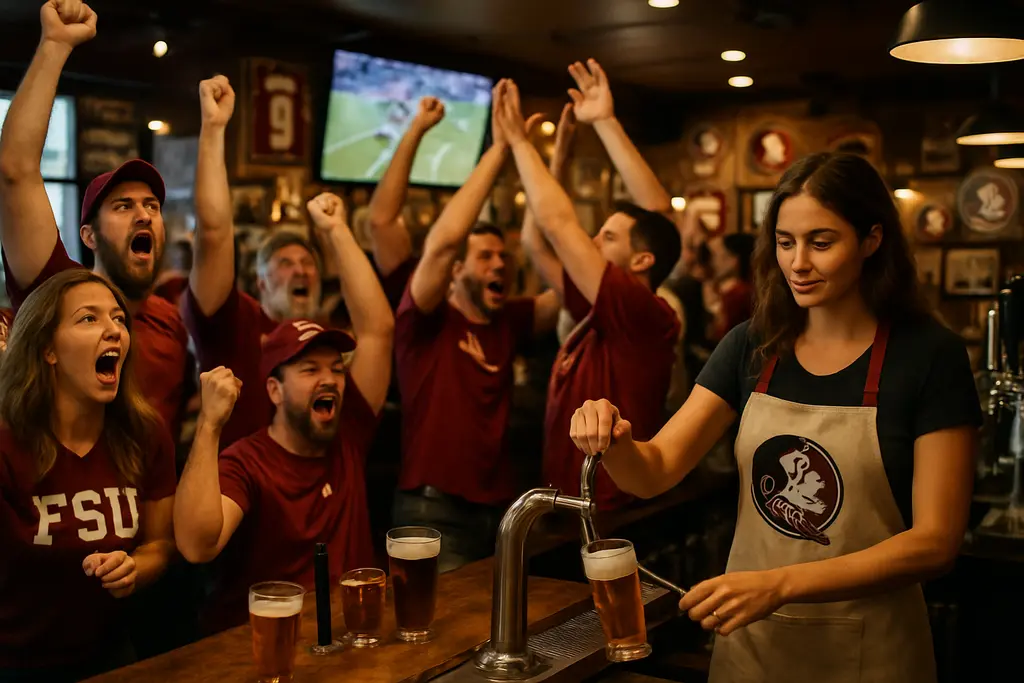
FSU Football Impact is not limited to what happens between the hash marks at Doak Campbell Stadium. In Tallahassee and across nearby Florida communities, the program touches hotel desks, restaurant kitchens, youth camp fields, student service projects, and family conversations about what local sports can mean. That reach is easiest to see on a home football weekend, but it also shows up in smaller ways: a child meeting a former Seminole at camp, a shop owner staffing up before kickoff, or a college student spending a Saturday morning helping a neighborhood site before the next campus event.
FSU Football Impact Beyond The Stadium
The strongest community sports programs create movement around them. Florida State football does that in Leon County because home games are not single-site events. They are travel weekends, family reunions, retail days, restaurant shifts, and hotel nights all at once. The scoreboard still matters most to the fan base, but the local footprint is measured in receipts, staffing plans, and repeat visits.
Reading FSU Football Impact In Local Spending
In fiscal year 2024, FSU home football games generated $106.5 million in economic impact for Leon County, with spending tied to lodging, meals, retail, and visitor activity, according to the FSU economic impact report. That number gives local context to something Tallahassee residents feel without needing a spreadsheet: football weekends change the pace of the city.
That is the clearest way to read FSU Football Impact outside the stadium. In the same fiscal year, out-of-town attendees booked 161,228 room-nights and spent $22,118,918 on lodging alone. The report also listed average attendee spending at about $87.38 per day and nearly $349.50 per trip. Those figures help explain why a home schedule can matter to people who never step inside the stadium. A hotel worker, a line cook, a rideshare driver, and a retail clerk can all feel the difference.
Why Marquee Weekends Stretch Across Leon County
Research notes tied to local business activity point to a familiar pattern: restaurants, bars, retailers, and clothing stores often see larger surges during football-related home weekends, with the biggest lift around marquee matchups such as Florida, Miami, or Clemson. The effect is not uniform for every business, and the available research does not provide a verified revenue change for each storefront. Still, the pattern is clear enough for anyone who has tried to find a table on a major game weekend.
For Tallahassee, those weekends are part logistics and part identity. Alumni return. Families meet downtown or near campus. Visiting supporters book rooms, eat local, and move through areas that might otherwise have a quieter Saturday. That local rhythm is why game-day planning belongs in the same conversation as civic planning. Parking, staffing, hotel availability, and restaurant supply orders all become part of the football calendar.
Youth Football Touchpoints That Start Early
Community impact is not only an adult economy story. Florida State football also reaches young athletes and families through camps, youth programs, and campus exposure. Not every child who attends a camp becomes a college player, and that should not be the only measure. The bigger value is access: young people seeing coaches, former players, facilities, and college life up close.
Panama City Camp Opened A Wider Door
On June 6, 2026, a free one-day camp in Panama City was hosted by former Seminole Javien Elliott and Coach Boris Jackson. The event was open to ages 9 and up and inclusive of all genders, based on the FSU calendar listing. The free format matters. Cost can be a real barrier for families, especially when travel, equipment, and summer schedules are involved.
A camp like that extends the program beyond Tallahassee while keeping the Florida State name tied to instruction and access. It also reinforces a point that often gets lost in recruiting talk: local talent development begins well before a prospect has stars next to his name. Footwork, confidence, coachability, and the simple feeling of belonging on a football field are built early.
Campus Camps Create Repeat Connections
In fiscal year 2024, FSU varsity sports programs hosted more than 3,310 football camp attendees, part of more than 8,500 total attendees across athletic camps for 2023-2024. Those numbers show how the campus functions as a sports classroom during periods when many fans are not thinking about standings or kickoff windows.
There is a recruiting angle here, but there is also a community angle. Families come to campus. Young athletes meet coaches. Parents learn routes, parking patterns, and campus spaces. A first visit for camp can become a later visit for a game, a school tour, or a family weekend. That kind of recurring contact builds familiarity, and familiarity is one of the quiet engines of local sports loyalty.
Service And Partnerships Around The Program

Football’s public profile gives players and athletics staff a platform, and the community can judge that platform by how it is used. The research record from 2025 and 2026 shows examples that reach beyond attendance and spending, including player service, student volunteer work, youth access, and business partnerships connected to Florida.
Players And Students In The Community
In September 2025, FSU football player Richie Leonard IV was named to the Allstate-AFCA Good Works Team in recognition of community service. The reported service included support for youth initiatives in Tallahassee and Cocoa, work with AAU teams, and arranging a $5,000 donation for a high school football program. That type of recognition matters because it gives fans another way to understand leadership. Blocking assignments and locker-room presence are part of the sport, but so is whether a player shows up for younger athletes watching from the fence.
The larger campus also contributed through the Big Event Tallahassee. On February 21, 2026, more than 1,100 college students from FSU, FAMU, and Tallahassee State College performed service work at approximately 40 sites across the city, including local businesses, nonprofits, and residences. That was not a football-only event, but it fits the same civic sports culture. A college town’s athletic identity is stronger when students and residents see each other outside the stadium as well as inside it.
Business Ties With A Florida Reach
FSU Athletics and Kin Insurance announced a four-year jersey-patch partnership on September 4, 2026, beginning with the 2026-27 season. The first appearance was tied to FSU’s September 7, 2026 game against SMU. The research describes the agreement as support for student-athletes and a way to strengthen community ties across Florida.
Partnerships like that can be read two ways. They are commercial agreements, yes, but they also show how college athletics now connects brands, athletes, and regional identity. For fans, the question is not just who appears on a uniform patch. It is whether the relationship feeds back into student-athlete support and keeps Florida State connected to the communities that help build its audience.
Why FSU Football Impact Still Belongs To Tallahassee
The best version of FSU Football Impact is local before it is anything else. It should help Leon County businesses prepare for high-traffic weekends, give young athletes more points of entry, and remind former players that their name still carries weight when they return to teach or serve. The program’s size can make it feel national, but its roots are measured in Tallahassee streets, Panhandle fields, and families who plan months around one Saturday.
The Community Standard Fans Can Measure
Fans can measure this standard in practical ways. Are youth events accessible? Do local businesses benefit from the calendar? Are players encouraged to serve in ways that outlast a news cycle? Are families with younger children being invited into the culture through programs such as Kids Club, which research notes began offering benefits in 2026 for children in eighth grade and younger, including free admission to selected home football games, in-game promotional opportunities, and Sportshop discounts?
Those questions keep the conversation grounded. They also connect with broader Seminole identity during a milestone period for the university; the same sense of campus pride discussed in our piece on FSU 175th anniversary and local sports pride applies here. Football is one of the most visible doors into Florida State, but the community decides how wide that door feels.
Keeping The Fan Zone Local
For the Fan Zone audience, the story is not about odds, predictions, or noise. It is about people. The owner ordering extra inventory before a major opponent comes to town. The young camper in Panama City taking instruction from someone tied to the Seminoles. The student-athlete using his platform for youth programs. The hotel staff managing another full weekend. These are not side stories. They are the local sports story.
Florida State football will always be judged on wins, losses, rivalries, and championships. That is fair. But in Tallahassee, the program also carries a community responsibility that shows up every time a home weekend fills rooms, every time a camp opens a path for a child, and every time the garnet and gold economy reaches a family-run business. That is where the bond between team and town is renewed.