

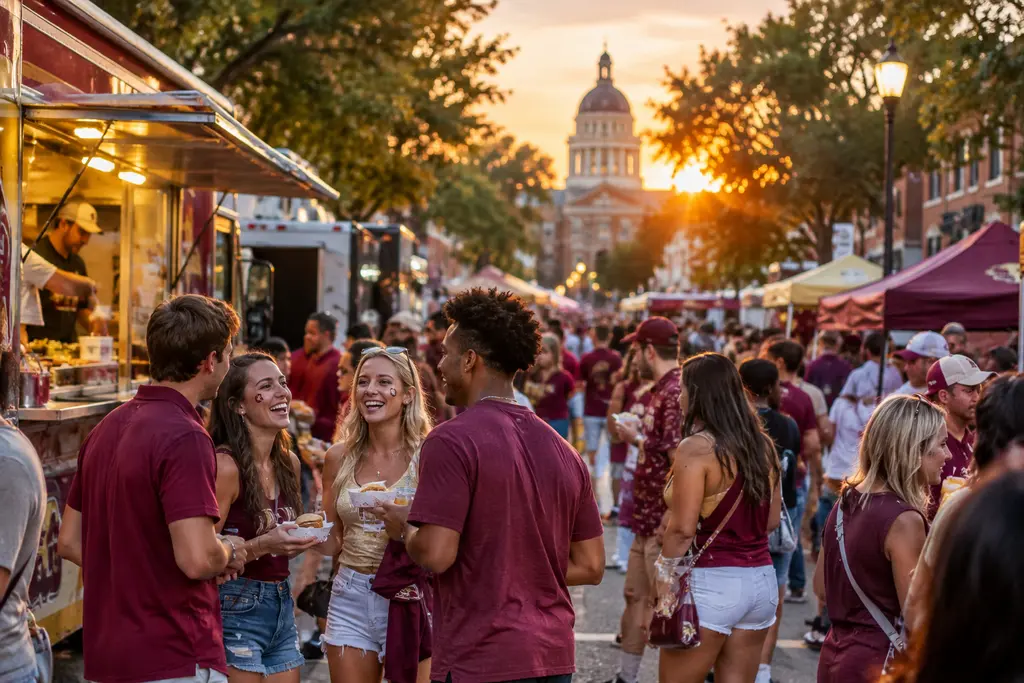
FSU home games have long been more than a scoreboard event in Tallahassee. They are a weekly civic test of traffic flow, restaurant staffing, hotel demand, student work schedules, family routines, and neighborhood patience. The 2024 football season, already completed as of October 27, 2026, gave Leon County another clear look at how deeply Seminole Saturdays reach beyond Doak Campbell Stadium and into the local business community.
That reach matters because college football in Tallahassee is not a self-contained entertainment product. It spills into Gaines Street, CollegeTown, downtown hotels, Capital Circle restaurants, South Monroe service stations, and the quieter corners of town where workers clock in before many tailgates are even open. A home date can feel like a football game to one family and a double shift to another. Both experiences are part of the same local sports story.
How FSU home games Reach Main Street
Weekend Traffic As Local Sports Infrastructure
The strongest numbers from the 2024 season show the size of the wave that arrived with football weekends. Florida State reported that 129,022 out-of-town visitors came to Leon County for home football games, with those visitors booking 161,228 room nights and spending an average of $87.38 per day and $349.50 per trip, according to the university’s economic impact report. Those figures turn a familiar Saturday scene into something more concrete: a sports calendar that functions as a seasonal business schedule.
Hotels feel that first. A family driving in from Tampa, Pensacola, Jacksonville, or Atlanta is rarely making a same-day trip if kickoff and postgame traffic stretch the day. Restaurants feel it next, especially during lunch windows, late dinners, and the breakfast rush the next morning. Retail follows in smaller but steady ways, from apparel stops to convenience purchases that rarely show up in a game recap.
What FSU home games Meant For Visitors
The visitor profile also tells us why local businesses plan around football instead of merely reacting to it. A typical season of home football was credited with about $106.5 million in economic impact for Leon County, counting both direct and ripple effects. That does not mean every corner of town benefits equally, and it should not be read as a guarantee for every operator. It does mean that home dates create a repeatable surge in demand that businesses can prepare for with staffing, inventory, hours, and partnerships.
That is where the sports story becomes a community story. A packed dining room after a night game is connected to offensive pace, broadcast windows, weather, parking access, and opponent draw. A hotel front desk on a rivalry weekend is part of the same event operation as the stadium gates. The game ends after four quarters; the local workday tied to it does not.
The Business Rhythm Around Doak Campbell
Restaurants Hotels And Retail Before Kickoff
The Office of Economic Vitality has reported that home football games contribute roughly $47.8 million in direct spending by visitors from outside Leon County per season, with restaurants, hotels, and other visitor-facing businesses positioned to benefit from that flow through its DataTALKS research. That figure fits what longtime Tallahassee residents already recognize: the football schedule is one of the city’s most reliable demand signals.
There is a reason restaurant managers study kickoff times. A noon game creates a different pattern than a prime-time game. Early kickoffs press breakfast and postgame dinner. Late starts stretch the afternoon and can turn patios, bars, and casual dining rooms into holding areas for fans moving toward campus. Retailers near student housing and hotel corridors also see behavior shaped by family visits, alumni reunions, and weather needs.
The Student Worker Connection
The labor side deserves equal attention. In Leon County, the restaurant, food service, and accommodations sector represents about 18% of all taxable sales, and 36% of employees in those industries are ages 18 to 24. That overlaps with the age group many people associate with the university itself. On football weekends, students are not only in the stands or tailgates; many are serving tables, checking in guests, running food, stocking shelves, and cleaning rooms.
That overlap gives Tallahassee’s game-day economy a personal edge. The same campus calendar that brings alumni home also shapes the shifts available to young workers. It can create earnings opportunities, but it can also bring pressure: longer hours, heavier crowds, transportation delays, and little margin for error when a rush begins. For fans, patience with service workers is not a small courtesy. It is part of respecting the local system that makes the weekend work.
For local businesses, the most practical lessons are often simple:
- Plan staffing by kickoff window: The rhythm of a noon game is not the same as a night game.
- Coordinate with nearby partners: Hotels, restaurants, and retailers can help one another anticipate crowd timing.
- Treat students as part of the sports economy: Their labor links campus life with visitor spending.
That connection is also why the topic has become a recurring local conversation. A related look at how home games fuel Tallahassee made the same point from another angle: the football weekend is a shared operation, not just a stadium event.
What The 2024 Numbers Tell Fans

Attendance With A Caveat
The supplied 2024 attendance notes deserve a careful read. They report an average of 53,479 attendees per game, while also listing 51,107 for the University of Florida game as the highest attendance. Those two claims cannot both be true as written. Rather than using that as a clean ranking, the safer takeaway is that the 2024 home schedule still concentrated tens of thousands of people around campus on game days.
That caveat matters because community impact reporting works best when it is honest about data limits. Fans do not need inflated claims to understand the scale. Anyone who has sat in traffic on Tennessee Street, waited for a table near CollegeTown, or watched hotel rates tighten around a major home date knows that attendance does not have to set a record to shape the city.
Beyond The Gate Count
Attendance is only one measure of impact. Out-of-town visitors are the key group for many local businesses because they bring new spending into Leon County rather than shifting money from one side of town to another. A local fan buying dinner after the game is valuable. A visiting family paying for two hotel nights, several meals, fuel, parking, and merchandise brings a different kind of lift.
That is why the 161,228 room nights tied to the 2024 home football season stand out. Room nights help explain why the business effect reaches beyond the blocks nearest Doak Campbell Stadium. A visitor may sleep near I-10, eat downtown, shop near campus, and stop for gas on the way out of town. The path is spread across the city, even when the reason for the trip is one stadium.
Why FSU home games Still Bind Tallahassee
A Community Measure Beyond The Scoreboard
The emotional center of a football Saturday is still the team. That is how it should be. But the community impact around the team is part of Florida State’s local identity, especially in a capital city where university life, state government, small business, and neighborhood routines overlap. A home game can be a reunion, a work shift, a sales spike, a traffic headache, a family weekend, or all of those at once.
For Tallahassee, the most valuable sports weekends are not only the ones with the loudest fourth quarter. They are the ones that remind residents how many people share the event in different ways. The chef prepping before sunrise, the hotel clerk handling late arrivals, the student worker closing after midnight, the alum bringing a child to campus for the first time, and the lifelong season-ticket holder walking the same route to the stadium all belong to the same civic rhythm.
That is the lasting value of FSU home games. They give Tallahassee a recurring stage where athletics, work, memory, and local commerce meet. The score determines the mood for a few days. The community ties built around the weekend last much longer.