

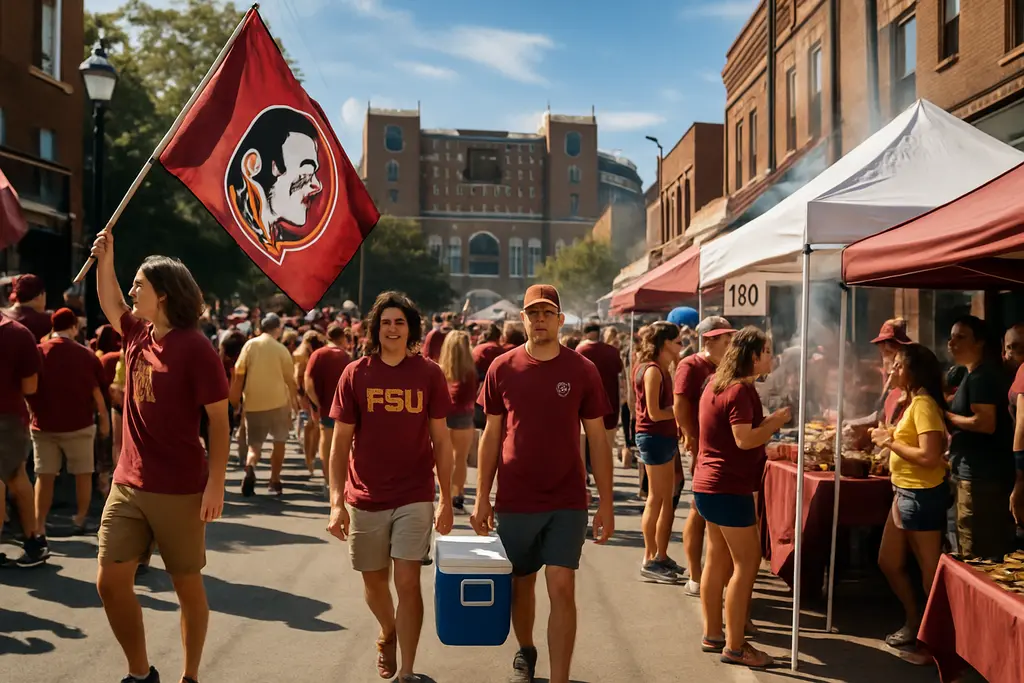
FSU home games are not just dates on a football calendar in Tallahassee. They are weekend markers for hotel clerks, restaurant managers, campus-area retailers, rideshare drivers, alumni families, students and residents who feel the city change pace when garnet and gold comes back to Doak Campbell Stadium. The scoreboard still matters first. But the local business story around Florida State football has become one of the clearest ways to see how college athletics connects campus, commerce and civic identity.
By the numbers available from Florida State and local economic development reporting, that connection was significant during the 2023-24 football cycle and fiscal year 2024. Florida State reported that home football games generated an estimated $106.5 million in total economic impact in Leon County in fiscal year 2024, according to Florida State economic impact data. That figure gives structure to what many locals already understood from experience: football Saturdays do not stay inside the stadium gates.
What FSU home games Meant For Leon County
FSU home games And The Weekend Rush
The most useful starting point is not the packed concourse or the marching band echoing through the stadium. It is the flow of people into Leon County. During the 2023-24 FSU football season, total out-of-town attendees for home games were listed at 129,022. Those visitors were not just passing through. The same Florida State economic impact data reported average spending of $87.38 per day and $349.50 per trip for out-of-town visitors tied to football weekends.
That kind of spending spreads across the ordinary places that make a sports town work. A family that drives in from Jacksonville may fill up before checking into a hotel. Alumni might eat downtown on Friday night, buy gear near campus on Saturday morning, and stop for coffee before heading home Sunday. None of those stops win a conference game, but they shape the financial week for workers and owners who count on predictable surges.
The power of FSU home games is that they compress demand into familiar windows. A business can plan around kickoff windows, staffing needs and inventory in a way that is harder with one-off events. That planning does not remove risk; weather, opponent draw, team record and travel habits can all shift the crowd. Still, football provides a rhythm that many local businesses understand because they have lived it for decades.
What The Reported Spending Shows
One useful caution belongs here. Economic impact reports can measure activity in different ways, and readers should avoid treating every number as interchangeable. A total economic impact figure, visitor spending, direct spending and attendance all answer different questions. In the research provided for this article, one attendance note listed a 2024 average attendance figure alongside a lower single-game high, which appears inconsistent on its face. For that reason, the stronger reading comes from the broader spending and visitor measures that are directly tied to Leon County activity.
That does not weaken the larger point. If more than 129,000 out-of-town attendees were connected to the 2023-24 home schedule, then football was functioning as a repeat tourism engine. Tallahassee is not Orlando or Miami, and it should not be judged by those tourism patterns. Its sports economy has its own shape: family weekends, alumni returns, student gatherings, visiting fans, and local residents who build their fall around campus traffic and Saturday routines.
How Game Weekends Move Money Through Town
Hotels, Restaurants And Retail Feel It First
For many local businesses, FSU home games create a short, intense sales window. Hotels are the most visible example because traveling fans need rooms, but the effect does not stop there. Restaurants near campus, Midtown, downtown and major corridors can all benefit when fans arrive a day early or stay after the game. Retailers connected to team apparel, gifts and tailgate needs also sit close to the heart of the spending cycle.
The Office of Economic Vitality has described the scale of football attendance across Tallahassee’s two universities, reporting that since 2022, home game attendance at Florida State and Florida A&M averaged 920,097 per season, with about 89% coming from FSU games, according to DataTALKS from the Office of Economic Vitality. That pairing matters locally. FSU and FAMU do not create identical sports weekends, but together they show how college football supports Tallahassee as a fall destination, not just a capital city with campuses.
The same local economic reporting placed a typical season’s direct spending by visitors from outside Leon County at about $47.8 million for FSU home football games, with another $7.3 million from FAMU games, contributing to an estimated $102 million economic impact per season for Leon County. Those are not abstract totals for a business owner scheduling extra servers or a hotel manager preparing for heavy check-in traffic. They are signals that staffing, supply orders and operating hours may need to match the football calendar.
Why Repeat Visitors Matter
One of the most valuable parts of a home football weekend is repeat behavior. Alumni come back to the same breakfast spot. Families find the same parking routine. Visiting fans learn which corridors move best after the game. Students bring parents to local favorites. That repetition builds habits, and habits are the part of sports economics that a spreadsheet can miss.
This is where community identity enters the picture. A national television audience may see the spear, the band, the stadium and the final score. Locals see the prep before sunrise, the cash registers after kickoff, the cleanup after dark, and the Sunday morning reset. The city absorbs football differently than the broadcast does. That lived pattern is why the business effect feels personal in Tallahassee.
There is a football side to this, too. Home schedules give fans reasons to rejoin the community in person, and those trips sustain relationships that online fandom cannot fully replace. For a closer look at that wider community connection, our piece on the FSU football impact across Leon County tracks how Saturdays reach beyond the field.
The Business Rhythm Around Doak Campbell Stadium

Planning Around Kickoff Windows
Game day operations in Tallahassee begin long before the ball is kicked. Businesses near the stadium and along fan travel routes often think in waves: Friday arrivals, Saturday morning tailgate runs, pregame meals, postgame traffic, late-night crowds and Sunday departures. The exact timing depends on kickoff, but the pattern is familiar enough that owners can prepare with more confidence than they might for a less predictable event.
That confidence has value. A restaurant can schedule more staff. A shop can order more team-colored merchandise. A hotel can manage room turnover. Even businesses that are not sports-themed can benefit when more people are moving through town. Football weekends create a temporary population bump, and the city’s service economy responds.
Still, the effect is not automatic for everyone. Traffic changes can help one corridor and slow another. A noon kickoff is not the same as a night game for dinner service. Weather can alter tailgate spending. A major opponent can draw more out-of-town interest than a lower-profile matchup. Local businesses know these differences because their receipts often tell the story by Monday morning.
The Human Side Of The Spending
The best way to understand this local business boost is to remember who is behind it. The hotel front desk worker handling a line of arriving alumni is part of the sports weekend. So is the cook pushing orders through a packed kitchen, the student worker folding shirts, the police and event staff managing crowds, and the family-owned business hoping the weekend covers a slower stretch later in the month.
That is why the numbers should not be treated as cold accounting only. A $349.50 average trip spend by an out-of-town visitor has a human trail. It might include a meal prepared by a local kitchen, a room cleaned by a hospitality worker, a keepsake bought for a child, or gas bought before the drive back home. In that sense, the economic story is also a community story.
Why FSU home games Matter To Tallahassee
The value of FSU home games is not only measured in wins, rankings or crowd noise, though those remain central to the fan experience. Their local value rests in repetition, identity and shared timing. For several weekends in a football season, Tallahassee moves to a familiar beat. Alumni return. Local businesses brace and benefit. Students connect campus life to the city around them. Residents adjust, complain, celebrate and participate in a ritual that has become part of how the capital understands fall.
The supported data from fiscal year 2024 and the 2023-24 season showed a sizable economic footprint in Leon County, led by visitor activity and game-weekend spending. The exact effect will always vary by schedule, kickoff time, opponent, weather and team momentum. But the broader lesson is steady: college football Saturdays in Tallahassee carry local weight beyond the final score.
For Florida State fans, that should deepen the way we read a home schedule. Each date at Doak Campbell Stadium is a sports event first, but it also becomes a civic event. The stands, the streets, the restaurants and the small businesses all share in the same weekend surge. That is the part of the story worth remembering after the lights go off.