

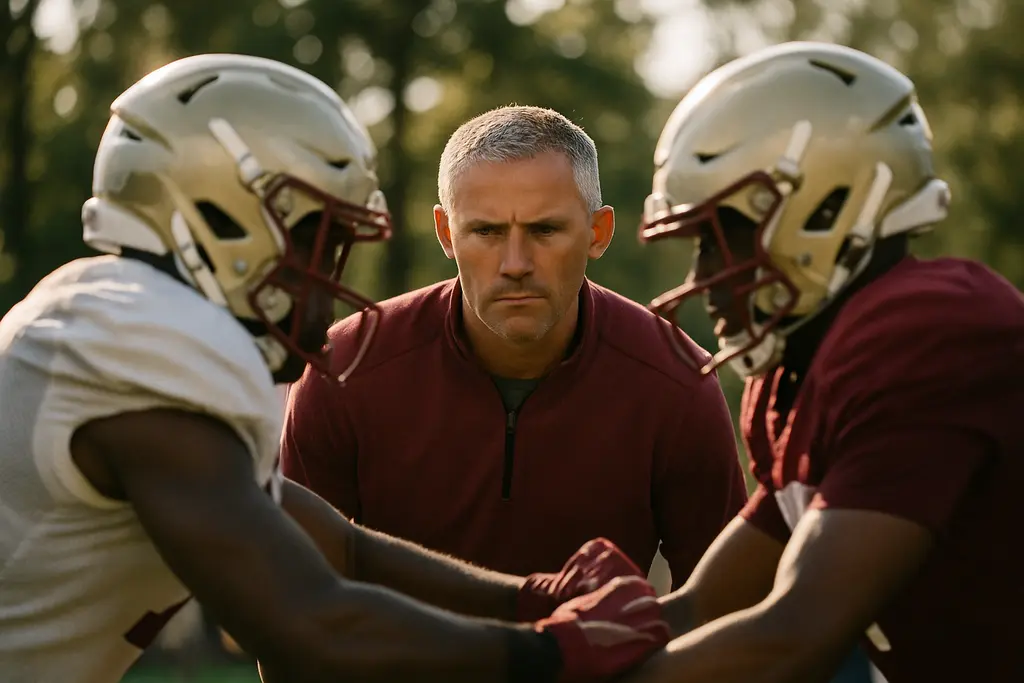
The Mike Norvell Strategy at Florida State has become less about a single depth-chart reveal and more about daily proof: who improves, who handles contact, and who can be trusted when a Saturday in Tallahassee turns tight. That is the thread running from spring 2025 roster rebuilding to August 2026 fall camp, where competition, older players, younger prospects and line-of-scrimmage growth all sat at the center of the conversation.
Florida State fans do not need a slogan to understand depth. They see it when a second-team tackle survives a hard series, when a freshman tight end earns red-zone work, or when a linebacker who was quiet in March becomes part of a camp package in August. Under Norvell, the roster build has leaned on two tracks at once: bring in enough proven college experience to raise the floor, and keep developing the next group so the program is not living week to week.
Mike Norvell Strategy Starts With Competition
The 2025 Newcomer Wave
In spring 2025, Florida State brought in 32 newcomers under Norvell: 19 transfers, 16 of them from Division I, and 13 true freshmen, according to an Everything Noles episode on Apple Podcasts covering Norvell and FSU spring additions. That number matters because it shows how direct the staff was about creating competition in practice. This was not a small trim around the edges. It was a roster reset with quarterbacks, receivers, linebackers and linemen joining a program that needed options across position rooms.
The most telling part was not simply the head count. It was the balance. Transfers gave Florida State players with college reps already on tape, while freshmen gave the staff longer-term developmental clay. For a coach who has often talked publicly about competition, that mix fits the message: nothing is gifted, but nobody is blocked from proving he is ready.
Mike Norvell Strategy And The Fluid Depth Chart
The Mike Norvell Strategy also showed up in August 2026 when Norvell described the depth chart as fluid and talked about packages that could let different players contribute, according to Sports Illustrated’s transcript of his fall camp comments from Norvell’s camp presser. That language is important because it pushes against the old idea that a two-deep is set in ink before the first meaningful stretch of the schedule.
Norvell also pointed to younger or less established players such as Desirrio Riles, Landon Thomas and Chase Loftin as players showing promise during camp. That does not mean all three were guaranteed major roles. It means the staff was publicly acknowledging development, and in a program like Florida State, that can be a powerful signal inside the building. Players hear who is earning mention. Teammates know whether that praise matches practice. Fans hear those names and start watching the second wave, not just the starters.
Experience Up Front Shapes The Standard
Transfers With Real College Snaps
Four transfer offensive linemen in that 2025 group, Gunnar Hansen, Adrian Medley, Luke Petitbon and Micah Pettus, had combined for 131 career games and 105 starts before arriving at Florida State. For a coaching staff trying to build a steadier offense, that type of experience is not cosmetic. It changes the tone of a meeting room. It gives younger players examples of college preparation. It also gives coaches more flexibility if injuries, fatigue or matchup issues force a rotation.
The broader transfer group from spring 2025 carried 489 games played and 244 starts, with production that included about 3,689 passing yards, 33 passing touchdowns, 1,438 rushing yards, 15 rushing touchdowns, 3,361 receiving yards and 20 receiving touchdowns. Those numbers do not promise wins by themselves. What they do show is that Norvell and his staff sought players who had already lived through college football Saturdays somewhere else.
Why The Trenches Became A Priority
Florida State also added 15 players on the offensive and defensive lines as of spring 2025. Around Tallahassee, that kind of roster note lands differently than a flashy skill-position headline. FSU fans have watched enough football to know that line depth decides whether an offense can stay patient and whether a defense can still tackle with force late in the fourth quarter.
The 2025 transfer class was ranked fifth nationally and first in the ACC by 247Sports, while the total class of high school signees and transfers ranked second in the conference. Rankings are not the story by themselves, but they do help frame intent. Norvell was not leaning only on a freshman cycle or only on a portal haul. He was trying to stack both, even if the work of turning a ranked class into a dependable Saturday roster still had to happen on the practice field.
Player Development Is A Local Trust Issue
Fans Notice Who Gets Better
Player development is not an abstract coaching phrase in Tallahassee. It is something people talk about at youth fields, high school games, campus tailgates and Monday lunch counters. Did the offensive line communicate better? Did the young tight end look more comfortable? Did the defense tackle with better leverage after halftime? Those questions shape how the community reads the health of the program.
That is why the Mike Norvell Strategy cannot be judged only by signing-day graphics or transfer rankings. The real test is whether new players become dependable players, and whether returning players keep climbing. In August 2026, Norvell’s comments about the best players playing the most fit that standard. He was not selling seniority. He was selling earned roles.
Fluid Does Not Mean Random
A fluid depth chart can sound uncertain from the outside, but inside a football building it can be a tool. If a staff uses packages well, the third receiver, the second tight end, the rotational tackle or the young linebacker can all have defined work without being full-time starters. That is how depth becomes real instead of decorative.
For Florida State, this matters because the Seminoles’ identity has often been built on waves of capable athletes, not merely a handful of headline names. The modern roster rules make that harder to sustain, but Norvell’s approach has been clear from the research available here: add competition, test players in camp, and leave room for movement if a younger player earns it.
What Fans Can Measure From The Stands

Signs Beyond The Starting Lineup
There are practical ways to read whether this roster approach is taking hold. Fans do not need access to every practice rep to see patterns once games begin. They can watch which position groups rotate without a drop in assignment quality. They can note whether younger players appear in specific packages instead of late-only situations. They can track whether the lines hold up when the first group needs rest.
- Rotation Trust: Are backups playing meaningful snaps because coaches trust them, not just because the game situation forces it?
- Line Depth: Do the offensive and defensive fronts keep their technique when substitutions arrive?
- Development Markers: Do names mentioned in camp, such as Riles, Thomas or Loftin, begin to show up in defined roles?
- Role Clarity: Are packages helping players contribute in areas that fit their growth stage?
Those are the details that turn camp talk into a season story. They also explain why local patience can be both demanding and fair. Tallahassee will give credit when a player grows. It will also spot quickly when depth is only a press-conference word.
The Human Side Of Roster Building
Every newcomer represents a family decision, a locker-room adjustment and a new place in the FSU community. Transfers arrive with college memories from other campuses. Freshmen arrive with family members hoping the next few years will shape them as students and athletes. That human piece often gets lost when roster math takes over.
Norvell’s task is to make the math and the people fit together. Thirty-two newcomers in spring 2025 meant new competition, but it also meant new relationships. The staff had to teach standards, evaluate quickly and keep returning players invested. For readers tracking the broader leadership arc, our earlier look at Mike Norvell’s leadership pairs with this roster discussion because culture and depth cannot be separated for long.
Why Mike Norvell Strategy Matters In Tallahassee
The Mike Norvell Strategy matters because Florida State football is not judged in fragments here. Fans remember the signing class, the spring quotes, the camp names, the first missed block and the first time a backup makes a play that saves a drive. The community connects those dots because FSU football has always been part scoreboard, part identity and part neighborhood conversation.
As of September 9, 2026, the supported picture is clear enough: Norvell leaned heavily into roster depth in spring 2025, especially through transfers and line additions, and he continued to speak in August 2026 about competition, flexible roles and development. The uncertainty is also fair to state. Public research does not prove exactly how every rep will be divided or which young player will become a fixture. What it does show is a coaching plan built around raising the floor while still leaving room for growth.
For Florida State, that is the balance that will define the next chapter under Norvell. Talent acquisition gets attention. Development earns trust. Depth wins over a locker room one role at a time. In Tallahassee, that is the part fans will keep measuring long after the camp quotes fade.