

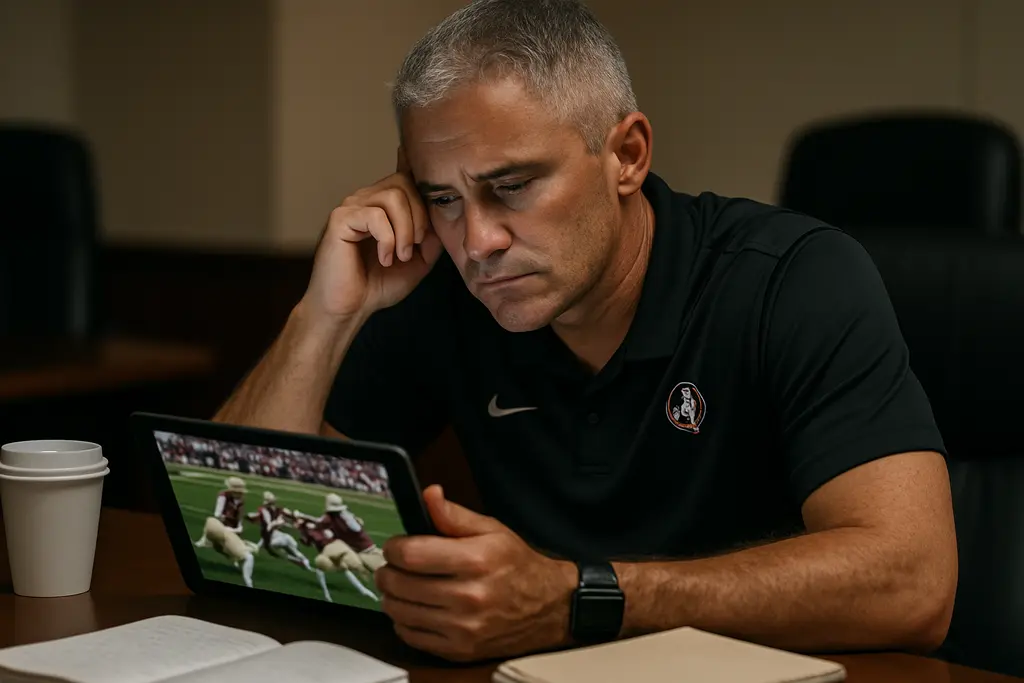
The Norvell adjustments after Florida State’s 27-24 loss to SMU on September 7, 2026, were not framed as cosmetic changes. They were framed as a direct response to a home game at Doak Campbell Stadium where the Seminoles forced four turnovers, had chances to shift the game, and still came away short. Mike Norvell’s message afterward carried a local edge because Tallahassee does not treat these games as box-score entries. The community sees them as proof points for development, discipline, and whether a roster can answer hard moments.
Norvell said Florida State forced four turnovers against SMU, two interceptions and two fumbles, but turned them into only seven points, a return he called “a failure” given the opportunities Yahoo Sports reported. That comment was the center of his postgame review. It pointed to a team that had defensive flashes but did not pair them with offensive control. For a program trying to grow trust after a difficult early result, the correction points were plain: finish drives, handle third down, and protect the quarterback when the game tightens.
Norvell Adjustments Start With Third Down
Why The Down-And-Distance Problem Stood Out
Florida State’s third-down issue was the clearest football problem to come out of the SMU loss. The Seminoles converted just 2 of 15 third-down attempts, including an 0-for-10 start, and Norvell called that performance “awful” according to Yahoo Sports. That number is not just a play-calling note. It changes how a stadium feels, how a defense gets rested, and how much pressure lands on every possession that follows.
For players, third down tests preparation in a way first down often does not. Protection calls, route timing, quarterback decisions, and spacing all get compressed. In a close game, a single missed assignment can end a drive that started with momentum. Norvell’s comments after the loss made it clear that Florida State could not treat third down as one isolated issue. The offense’s 0-for-10 start put the Seminoles in a position where takeaways did not carry full value.
Norvell Adjustments In Protection
The late-game protection breakdown may have been the most visible example. Norvell addressed a critical sack on third down during Florida State’s final drive, after the offense had received an interception and had a chance to move toward the lead. He said mistakes like that cannot happen in key moments. That is where Norvell adjustments move from practice-field language into the lived experience of a quarterback, linemen, and skill players trying to operate under stress.
Florida State also changed personnel on the offensive line during the game to help protect Ashton Daniels, with Norvell saying the staff made “a change within it” to try to stabilize protection. That kind of in-game move tells us the staff saw the issue clearly, but the postgame focus was not simply that a change was made. It was whether the protection, communication, and execution could hold when SMU forced the Seminoles into obvious passing spots.
Takeaways Needed More Offensive Reward
Four Chances, Seven Points
The most frustrating part for Florida State was that the defense gave the offense multiple openings. Four turnovers should give a home team room to seize control, especially in front of a crowd that is ready to tilt the energy after a takeaway. Instead, FSU managed only seven points from those possessions. Norvell did not soften that point, and he did not turn it into a complaint about effort. He treated it as a standard issue.
That matters for the local locker room because defensive players read those moments, too. A takeaway is not just a statistic. It is a burst of trust from one side of the ball to the other. When the offense does not cash it in, the defense is asked to keep answering. The Seminoles had enough defensive disruption to create hope, but not enough complementary football to make those takeaways define the night.
Rushing Positives And Passing Frustration
Norvell did point to some positives. He said Florida State was doing some good things in the run game and was able to create takeaways. At the same time, he acknowledged that the passing game “never really got in rhythm,” a central concern in the 27-24 defeat as covered by Yahoo. That balance in his review is worth noting. He did not describe the performance as empty. He described it as incomplete.
For a staff built around player development, that distinction matters. The run game can be a base, but the passing game has to punish defenses that crowd the line or win early downs. If Florida State can run in stretches but cannot hit enough timing throws, third downs grow longer and pass rushers can play faster. That is why the passing rhythm issue connects directly back to protection and drive finishing.
Communication And Technique Became The Local Message
Defense Had Its Own Review
Norvell also addressed defensive third-down issues after the SMU loss. He pointed to alignment, execution lapses, and players trying to do too much, while placing responsibility on both coaching and player performance. That shared accountability fits what Tallahassee listeners expect after a loss: not finger-pointing, but a clear explanation of what has to be corrected.
SMU’s offense produced far more yardage than Florida State’s offense in the game, with the research notes citing 585 yards for SMU and 324 for FSU. The allowed yardage gives context to Norvell’s concern about explosive plays and defensive execution. Turnovers kept the Seminoles in the game, but explosive gains and failed third-down answers prevented the defense from fully controlling the rhythm.
Why Fundamentals Were More Than A Talking Point
Afterward, Norvell emphasized communication, fundamentals, technique, and cleaner game-plan execution. Those words can sound routine after a loss, but this was not a generic coach-speak file. The problems he named showed up in the exact moments that decide close games: third-down protection, third-down defense, drive finishing after takeaways, and passing timing.
There is also a community layer to that message. Florida State football is watched closely by high school players across the region, by families who track development, and by former players who know how narrow the margin can be. A loss like this becomes a teaching film far beyond the team facility. For more on how the matchup shaped the conversation around ACC pressure, our earlier piece on the FSU SMU matchup tracked similar themes from the same result.
What Changed In The Staff’s Public Standard
Control What Can Be Controlled
Norvell did not lean on external noise after the game. The research notes say he did not allow fan boos or delays to become the focus, and instead pointed back to preparation, focus, and execution. That is an important public standard. In Tallahassee, the crowd reaction is part of the environment, but it cannot become the explanation for missed assignments or failed conversions.
The Norvell adjustments were less about a dramatic reset and more about tightening what the staff already values. Offensive balance, big-play awareness, and matchup preparation were part of the response after September 7. Because the Alabama game on September 19, 2026, has already passed as of October 9, 2026, the SMU comments should be read as the staff’s stated priorities from that point in the schedule, not as a preview of a future matchup.
A Development Lens For The Roster
The strongest local takeaway is that Florida State’s issues were teachable but costly. A team can build from forced turnovers. A team can build from successful runs. It is harder to build if the same down-and-distance problems keep taking away possessions. That is where practice habits, film review, and position-room accountability have to show up.
For younger players trying to earn trust, the SMU game offered a clear lesson: effort can put you in position, but detail decides whether a play becomes a win. The staff’s challenge was to turn that lesson into cleaner work without losing the disruptive traits that produced four takeaways in the first place.
Why Norvell Adjustments Matter In Tallahassee
The reason Norvell adjustments mattered so much after the SMU loss is that Florida State had enough opportunities to win a close game and enough mistakes to explain why it did not. That combination always lands hard in Tallahassee. It asks the staff to be honest, the players to be precise, and the fan base to separate promise from performance.
Norvell’s review gave a clear map of the problems: third downs, protection, passing rhythm, defensive alignment, and turning takeaways into points. None of those areas sit outside coaching. None sit outside player responsibility. The next step for Florida State was not to talk around the loss, but to use it as a measuring stick for the standards the program wants attached to its name.